HOME   SCHOOLS   REGISTRATION JOBS   PURCHASING NNPS-TV SUBSCRIBE & SHARE Become a fan of our Facebook page. Follow @nnschools on Twitter. RSS Feed: News & Announcements RSS Feed: Closings & Cancellations Subscribe to NewsLines e-newsletter. NNPS on Google+
  
Newport News Public Schools
  12465 Warwick Boulevard   •  Newport News, VA 23606  •  Phone: (757) 591-4500

Smart, Safe Schools!

MATHEMATICS DEPARTMENT

“NNPS = Achieving Mathematical Excellence, One Student at a Time”

Mathematics Program

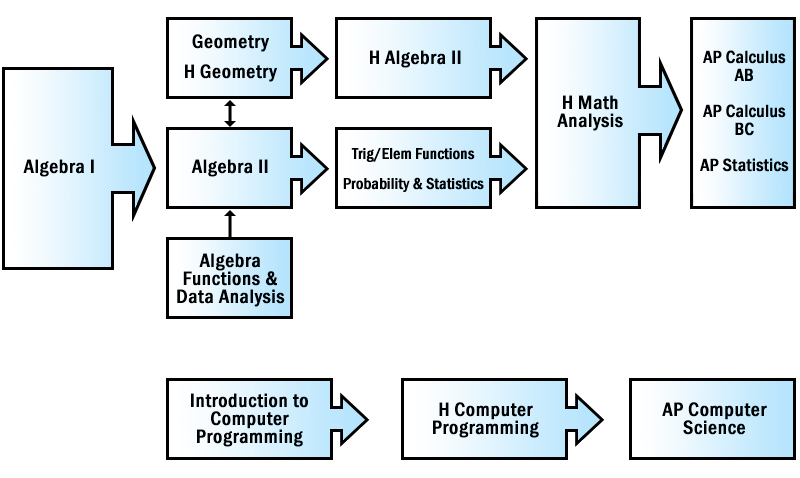
Students today require stronger mathematical knowledge and skills to pursue higher education, to compete in a technologically oriented workforce, and to be informed citizens. Students must gain an understanding of fundamental ideas in arithmetic, measurement, geometry, probability, data analysis and statistics, and algebra and functions, and develop proficiency in mathematical skills at all levels. High school credit classes reinforce these topics in specific courses including: Algebra I, Geometry, Algebra II, Trigonometry, Math Analysis, Calculus and Probability and Statistics. In addition, students must learn to use a variety of methods and tools to compute, including paper and pencil, mental arithmetic, estimation, and calculators. Graphing utilities, spreadsheets, calculators, computers, and other forms of electronic information technology are now standard tools for mathematical problem solving in science, engineering, business and industry, government, and practical affairs. Hence, the use of technology must be an integral part of teaching and learning. However, facility in the use of technology shall not be regarded as a substitute for a student’s understanding of quantitative concepts and relationships or for proficiency in basic computations.

The content of the mathematics standards is intended to support the following five goals for students:

  • Becoming mathematical problem solvers
  • Communicating mathematically
  • Reasoning mathematically
  • Making mathematical connections
  • Using mathematical representations to model and interpret practical situations.

Each of these goals supports the idea that mathematics provides a systematic way to represent relationships and analyze change in our world.

Enduring Understandings and Essential Questions

Mathematical problem solvers apply a variety of strategies and methods to solve problem situations.

  • How do we become good problem solvers?
  • How do we select a strategy(ies) or method(s) to solve problems?
  • How do students apply prior knowledge to solve math problems?
  • To what extent do mathematical problem solvers use critical thinking?
  • How can technology assist in the problem solving process?

The language of mathematics is communicated through specialized vocabulary and symbols used to represent and describe mathematical ideas, generalizations, and relationships.

  • How is the language of mathematics used to communicate?
  • To what extent is the vocabulary in mathematics specialized?
  • To what extent does the learning of mathematical vocabulary help with communication?
  • How is the language of mathematics communicated through specialized vocabulary and symbols?
  • Why do we use generalizations?
  • How do we make connections between mathematical ideas?
  • How do we use mathematical language to show relationships in our world?
  • How is technology used in the representation and communication of mathematical ideas?

Mathematical reasoning is evidenced by testing and evaluating statements and justifying steps in mathematical procedures.

  • Why do we need mathematical reasoning?
  • How do we evaluate mathematical statements?
  • Why do we need to justify our steps in mathematical procedures?
  • How do we know when we have reasoned mathematically?
  • How do we know when we have tested a statement effectively?
  • To what extent can technology be used to test, evaluate and justify mathematical reasoning?

Connections are made within different areas of mathematics and between other content disciplines. Mathematics is also connected to real world applications.

  • How are connections made within different areas of mathematics?
  • To what extent are mathematical ideas connected to other disciplines?
  • To what extent is mathematics connected to real world applications?
  • How can technology be used to illustrate or discover connections among mathematical ideas?
  • Why should we understand the connections of mathematics to the real world and other content disciplines?
  • To what extent do we make connections to build relationships between algebra, arithmetic, geometry, measurement, discrete mathematics, probability and statistics?

Representing mathematical ideas involves using a variety of representations such as graphs, numbers, algebra, words, and physical models to convey practical situations.

  • Why is it important to use models to represent mathematical ideas?
  • To what extent can physical models be used to represent practical situations?
  • How can graphical information be applied to practical situations?
  • To what extent do numbers play an important role in mathematical ideas?
  • To what extent do physical models help us move from concrete and pictorial to symbolic and abstract thinking?
  • How can algebra be used to represent abstract ideas?
  • How are symbols and vocabulary used to translate between verbal ideas and the language of algebra?
  • How can technology be used to model mathematical ideas?

 QUICK LINKS
       
 | Terms of Service | Privacy | Non-Discrimination | Internet Safety